

Understanding Fascia: The Fabric That Holds Us Together
When most people think about the human body, they picture muscles, bones, and organs. But there is another crucial component that often goes unnoticed: fascia.
What is Fascia?
Fascia is best described as the biological fabric that holds us together. It is a network of connective tissue that forms a continuous, three-dimensional web throughout the body. This intricate structure provides cohesion and ensures that the body functions as a single, unified system.
From a contemporary perspective, fascia is a 3D spider web of fibrous tissue, ground substance (extracellular matrix), and proteins like elastin and collagen. These elements work together to maintain the proper placement of tissues and organs.
Functions of Fascia
Fascia plays a critical role in the body, offering both structural and functional benefits:
- Shape and Separation: It provides shape and form to contractile tissues, separating them into compartments.
- Sensory Organ: Fascia detects pressure and stretch, contributing to proprioception (awareness of body position) and introspection (internal sensing).
- Visceral Support: It compresses and supports internal organs, or viscera.
- Biomechanical Regulation: Fascia absorbs and translates mechanical energy throughout the body.
- Joint Support: It can act as a lubricant to reduce friction while also providing structural support to joints.
- Energy Translation: Fascia can absorb mechanical energy and distribute it efficiently.
- Support and Structure: It ensures tissues and organs remain in their proper positions..
How Fascia Works
Fascia is a relaxed, wavy connective tissue that becomes less malleable when damaged by trauma or inflammation. This damage can cause fascial layers to tighten, restricting movement, reducing blood flow, and potentially causing pain or a limited range of motion.
Depending on its location, fascia can either provide structural support or act as a friction-reducing layer.
Types of Fascia
Fascia is categorized into four main types:
- Superficial Fascia: Located just beneath the skin and superficial adipose layers, this fascia is composed of loosely packed, interwoven collagen and elastic fibers. It is generally thicker in the trunk and thinner in the limbs, sometimes incorporating muscle fibers to create specific structures.
- Deep Fascia: Surrounding bones, muscles, nerves, and blood vessels, deep fascia is more fibrous and dense than superficial fascia. It contains well-developed lymphatic channels and is highly vascularized. Deep fascia is further divided into two subtypes:
- Aponeurotic Fascia: Thicker and more easily separable from muscles.
- Epimysial Fascia: Thinner and more tightly connected to muscles.
- Visceral Fascia: This type of fascia surrounds specific organs, such as the lungs, heart, and stomach, providing support and aiding in introspection.
- Parietal Fascia: Found lining body cavities, such as the pelvis, parietal fascia supports structures and maintains the integrity of cavity walls.
Fascial Lines and Their Functions
Fascial lines provide a deeper understanding of how fascia connects and supports the body. Below are the primary fascial lines and their functions:
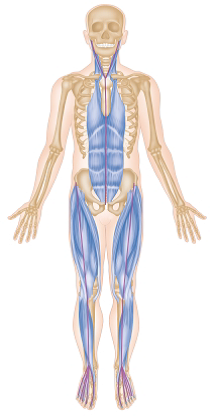
Superficial Front Line (SFL)
- Function: The SFL connects the skull to the toes, enabling movements like bringing the skull toward the toes and vice versa.
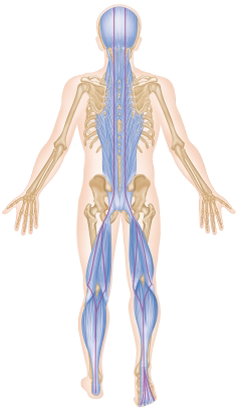
Superficial Back Line (SBL)
- Function: The SBL supports movements that bring the back of the skull toward the heel (calcaneus) and the calcaneus toward the back of the skull.
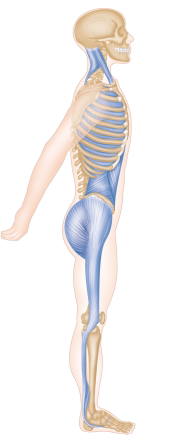
Lateral Line
- Function: The LL balances posture from left to right and mediates forces between the other superficial lines.
Spiral Line (SL)
- Function: The SL crosses all planes of movement, connecting the knee to the hip joint and influencing knee-tracking efficiency.
Principles of Training Fascia
To keep fascia healthy and functional, it’s important to focus on practices that enhance its elasticity, hydration, and responsiveness. Here are some key principles for training fascia:
- Preparatory Counter-Movement: Increase elastic recoil by pre-stretching the fascia.
- Movement Quality: Focus on controlled, dynamic movements with an emphasis on range of motion.
- Dynamic Stretching: Engage in stretches that involve movement rather than static holds.
- Proprioceptive Refinement: Enhance body awareness through mindfulness-oriented movement explorations.
- Hydration and Renewal: Use techniques like foam rolling or other myofascial self-treatment tools to maintain hydration and release tension.
Conclusion
Fascia is much more than a simple connective tissue; it is a dynamic, complex network that impacts nearly every aspect of our physical health and movement. By understanding its structure, lines, and functions, we can better appreciate its role in maintaining overall well-being. Whether through therapeutic interventions or proactive training techniques, taking care of your fascia is an essential step toward optimizing your body’s performance and health.
At Foundation Physiotherapy, our skilled massage therapists can help you address fascial restrictions and improve your movement patterns.