

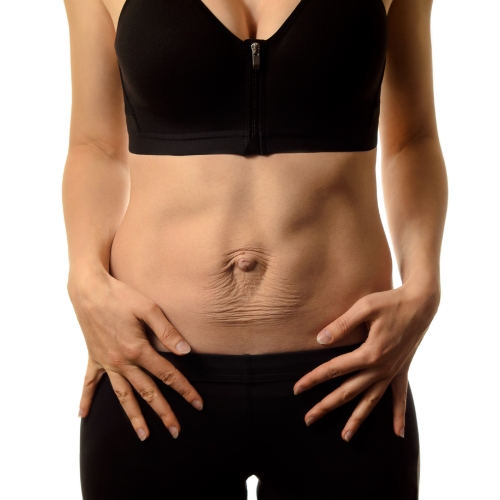
As your uterus continues to expand throughout your pregnancy, your abdominal muscles stretch and lengthen. Your rectus abdominis muscle is particularly affected. This muscle has two sides that run perpendicular from the rib cage to the pubic bone, connected in the middle with connective tissue called the linea alba. In order to allow for your baby to grow, the connective tissue of your linea alba thins and widens, increasing the space between the sides of your rectus abdominis muscle. In many cases, this separation resolves itself after delivery, as your abdominal muscles gradually gain back their strength. However, for some women, this separation may persist and impact their ability to rehab after their pregnancy.
Symptoms of a persistent or worsening rectus diastasis include:
- A noticeable bulge or tenting across the midline of your stomach during an activity that challenges your abs or increases abdominal pressure (may be observed during or after pregnancy)
- Lower back pain during postpartum exercise or activities
- Difficulty regaining abdominal tension after pregnancy or the appearance of a “mummy tummy”
- Difficulty with daily activities that require abdominal strength, such as getting up from a lying down position or lifting
Again, some women are at a higher risk of developing persistent diastasis compared to others. Some of these risk factors include:
- Being over the age of 35
- Being pregnant with multiple babies
- Having given birth in the past
- Giving birth to a baby with a high birth weight
- Sedentary lifestyle prior to pregnancy
- Fitness lifestyle that involves crunches, sit-ups, or v-sits
- Chronic slouched posture, rounded shoulders
- Increased elasticity of connective tissue or ligaments (genetic)
Read Reviews From Clients Who Found Relief With Physiotherapy
Treating Rectus Diastasis:
Treating rectus diastasis involves taking an in-depth look at the muscles of your core and how they work together to create trunk stability and manage intra-abdominal pressure. There is no secret list of “good” exercises and also no list of “bad” exercises when you have a diastasis. Whether a specific exercise is appropriate for you, depends on the situation, your form or technique, and the strategy that you use to do the exercise.
Another important note about diastasis is that recent research is directing us away from just looking at the space between the sides of your abdominal muscles. The degree to which you are able to generate tension through the connective tissue (linea alba) is also very important.
At Foundation Physiotherapy, we assess the abdominal muscles of all of our pregnant or postpartum clients. During pregnancy, our approach will be to monitor and help you modify your activities gradually as your pregnancy progresses, in order to prevent a more significant separation. After pregnancy, the focus is on regaining abdominal muscle tension and reducing the separation. With intervention this can occur much more quickly, allowing you to return to fitness or daily activities with confidence.
If you suspect that you have a diastasis, or have any concerns about how it may impact your pregnancy or recovery, schedule an appointment at Foundation Physiotherapy & Wellness today.
This service is available at


Lamiya Zaidi
PT
Registered Physiotherapist, Pelvic Health Physiotherapist

Karlyn Driedger
PT, CIDN
Clinic Director, Registered Physiotherapist (Partner Associate), Pelvic Health Physiotherapist

Stephanie Fleming
PT
Registered Physiotherapist, Pelvic Health Physiotherapist, Strength and Conditioning Consultant, Dance Rehab and Performance Consultant, Running Consultant

Annika Lonsway
PT
Registered Physiotherapist, Pelvic Health Physiotherapy, Strength and Conditioning Consultant

Kanupriya Garg
PT
Pelvic Health Physiotherapist

Holly Henderson
PT
Pelvic Health Physiotherapist

